Maternity Bra Fitting Guide
Measure & Fit Correctly at Every Stage
Written on 01 January 0001
Maternity Bra Fitting Guide – Measure & Fit Correctly at Every Stage
How to measure and fit correctly throughout pregnancy
Pregnancy changes your body in remarkable ways, and your lingerie should adapt with you. This guide explains exactly how to measure for a maternity bra, what to expect as your size changes, and how to stay supported from the first trimester through to nursing.
Why maternity bra fitting is different
Pregnancy is not static, your ribcage expands and your cup size grows, sometimes by several sizes. Standard bras are made for fixed measurements, but maternity bras are built to stretch, support and flex as your body changes.
Most women notice changes early, so regular measuring about every six to eight weeks helps maintain comfort and support. Explore the full Maternity Bras Collection for every stage of pregnancy.
How to measure for a maternity bra
Answer: Use a flexible tape measure to find your band and bust sizes, then calculate your cup difference. Always measure wearing a lightly lined or non-padded bra for accuracy.
What you’ll need
- A soft fabric tape measure
- A mirror to check tape position
- Someone to help if possible for accuracy
- A notepad to record results
Step 1: Measure your band size
Wrap the tape snugly around your rib cage, directly under your bust. Keep it level with the ground. Round to the nearest even number, that is your band size. If you measure 33 inches, round up to 34.
Step 2: Measure your bust
Measure around the fullest part of your bust, keeping the tape parallel to the ground and not too tight. This should be done standing straight and breathing normally.
Step 3: Find your cup size
Subtract your band size from your bust size. Each inch of difference equals one cup size:
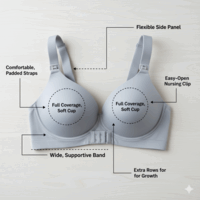 Diagram: How to measure your band and bust for a maternity bra
Use this chart to find your maternity bra cup size
| Difference (inches) |
Cup size |
| 1 |
A |
| 2 |
B |
| 3 |
C |
| 4 |
D |
| 5 |
DD |
| 6 |
E |
| 7 |
F |
| 8 |
FF |
| 9 |
G |
| 10 |
GG |
Example: if your band size is 34 and your bust measures 40, the difference is six inches, giving you a 34E. You can also try our Pregnancy Bra Size Calculator for a digital fit check.
When to measure during pregnancy
Your body evolves through each trimester, measuring regularly ensures continued comfort.
First trimester (weeks 1–13)
Tenderness and swelling begin early. Expect about one cup size increase. Measure at week 8 and again at week 12.
Second trimester (weeks 14–26)
Significant growth happens now. Both band and cup sizes often increase. Re-measure every six weeks.
Third trimester (weeks 27–40)
Breasts reach maximum size and your rib cage widens. Comfort and stretch are vital, measure at weeks 32 and 36.
Postpartum
Milk production changes everything again. Re-measure before and after your milk comes in to find your new nursing size.

How to check your maternity bra fit
Answer: The right maternity bra should lift, support, and stay in place without gaps or pressure points.
- Band: Should sit level and snug, not riding up.
- Straps: Adjust easily, no digging or slipping.
- Cups: Smooth fit with no bulging or gaping.
- Centre front: Lies flat against your chest.
- Underwire: If present, should sit behind all breast tissue.
- Movement: Raise your arms, the band should stay in place.
- Comfort: You should forget you are wearing it.
Common maternity bra fitting problems
Quick reference: what to adjust
- Band rides up: Band too large, size down.
- Spillage or bulging: Cup too small, size up.
- Gaps in cups: Cup too large or wrong shape.
- Shoulder pain: Band too loose, tighten or size down.
- Centre does not lie flat: Cup too small or band too big.
- Underwire digs in: Try a wire-free style or correct size. See our Maternity Bra Tips for more solutions.
Size progression throughout pregnancy
Understanding growth helps you plan purchases and stay comfortable.
- First trimester: 1 cup size increase
- Second trimester: 1 to 2 additional cup sizes
- Third trimester: May stabilise or increase slightly
- Band size: Often rises 1 to 2 sizes
- Postpartum: Further 1 to 2 cup size increase when milk arrives
Everyone grows differently, these are averages, not rules. Re-measuring and adjusting ensures your bras always fit properly.
When to switch to nursing bras
Answer: Most women transition to nursing bras around week 36. Nursing bras provide stretch and clip-down access for breastfeeding. They work well before and after birth. Explore our Nursing Bras range for flexible, feeding-friendly support.
Tips for buying maternity bras
- Start on the loosest hook: Tighten as your band stretches over time.
- Look for adjustability: Multi-hook bands and stretchy fabrics adapt best.
- Consider support: Maternity Support Bras ease pressure on your shoulders and back.
- Buy in multiples: Rotate 2 to 3 bras to extend lifespan and maintain shape.
- Prioritise comfort: Choose soft, breathable fabrics. See our Best Bras for Pregnancy for everyday favourites.
How to care for your maternity bras
Hand-washing preserves elasticity and comfort. Use mild detergent and cool water, rinse gently, and avoid wringing or tumble drying. Lay flat to dry. Proper care keeps your bras supportive for longer.
Get the perfect fit
Measuring regularly and adjusting your fit keeps you comfortable and confident throughout pregnancy and breastfeeding. Explore the full Nursing & Maternity Bras range to find soft, supportive styles that grow with you, or visit our Postpartum Lingerie Guide for comfort after birth.